














.jpg)







What Is Property Development Finance?
Property development finance is a short-term loan specifically designed to fund property construction, conversion, or heavy refurbishment plans. It helps property developers to proceed with profitable projects when they do not have large volumes of cash on hand.
You can use development finance if you’re looking to:
- Build from the ground up
- Convert a space
- Refurbish an existing property
Unlike traditional loans, property development finance caters to the complexities of construction and renovation projects, with funds typically released in stages that align with progress.
Development loans are complex funding arrangements to set up and administrate, and most development finance lenders are unwilling to consider borrowing requirements of less than £200K.
An initial amount is typically used to purchase the site or refinance existing debt. Following this, the lender monitors your progress, and the remaining funds are drawn down to cover costs as needed.
You pay interest on what you use, giving you the flexibility to borrow efficiently according to the demands of your project. The interest is typically paid in full at project completion, to help with cash flow during the project.
After completing your project, you repay the property development loan through the sale of your property or by refinancing it to a standard mortgage product. Depending on what you’re using the property for, this could be:
- Residential mortgage: for when you plan to live in the property
- Buy-to-let mortgage: for when you plan to let the property
- Commercial mortgage: for when you plan to use the property for business
How Property Development Finance Works
Property development finance typically works as a staged release of funds:
- There is an initial release, generally used to purchase the required land or the property for renovation, for example
- The rest of the funds are disbursed in stages to cover construction costs
- Lenders carefully monitor your progress against the information provided during the application process, ensuring your project stays on track
This system is in place to act as a safety net for developers and lenders, mitigating risks and maintaining the project's momentum.
The staged funding process means your loan is allocated effectively, and you’re not paying interest on chunks of your loan that you can’t actually spend yet.
What Is Rolled-Up Interest?
Lenders will usually want to see the interest payable on your loan rolled up into the total loan amount and repaid at the end of your term.
The most advantageous feature of development finance is that funds are made available as and when they are needed – so clients don’t pay interest on finance that hasn’t yet been drawn down.
What Is Staged Drawdown?
Staged drawdown on a development loan means you can draw out chunks of your loan as and when they're needed for your project.
You'll only be charged interest on what you have drawn from your loan, so for the majority of your project, you won't be paying interest on the full amount that you've agreed to borrow - only what you've drawn and actually spent so far.
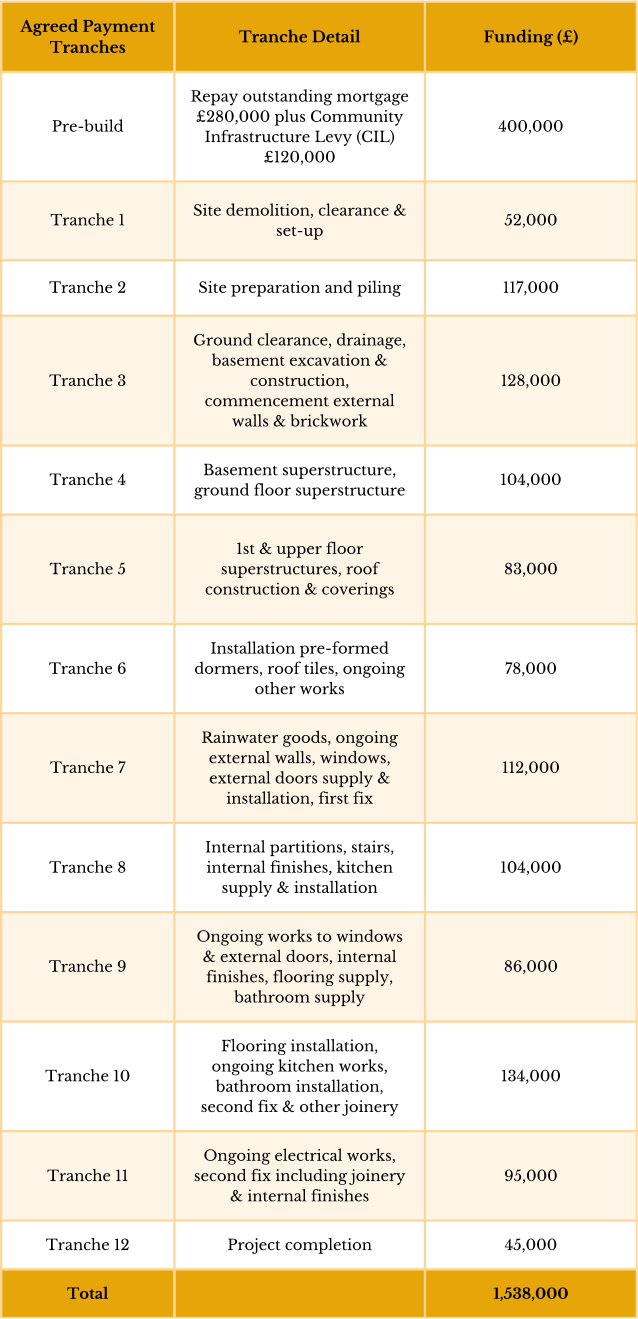
Example of Property Development Finance Drawdown Tranches
The following drawdown tranches are an illustrative example based on a scenario involving:
- A first-time developer
- A 6-bed, 6-bathroom luxury Southwest London residence
- A knock down and rebuild project
The Role of an Independent Monitoring Surveyor (IMS)
Your progressive drawdown of funds needs to be agreed upon in the loan schedule for your project, and an IMS appointed by your lender (but paid for by you) will make site inspections at each stage to confirm that progress is on schedule before your next tranche of funds is released.
The IMS acts as the lender’s eyes and ears on the project and will flag up any potential issues to them.
It’s in both your and your lender’s interest that your project proceeds on schedule, but funding delays can arise if busy developers don’t schedule site inspections with sufficient notice.
How Much Can You Borrow with a Development Loan?
The amount of funding you'll have access to will be determined by a lender’s valuation report.
A lender's valuation report determines:
- The property's current value: the value of the site with planning permission or the value of the property before refurbishment
- Project build costs: the amount that will need to be invested into the project to complete the proposed works
- Gross development value (GDV): the market value of the completed property or properties when all works are complete
Each lender will have its own lending parameters determining the maximum amount they’re willing to lend, with different finance options structured around valuation and risk.
A lower GDV of around 50% will help you access lower development finance rates, while very few lenders are willing to lend above 70% GDV on development projects. Across the wider development finance market, specialist lenders and traditional lenders may have different appetite depending on market conditions and the project type.
What Does GDV Mean in Property Development?
GDV stands for Gross Development Value. It is the projected market value of all properties in a development once all works are completed. You can also think of it as the total revenue the developer expects to receive after all properties have been sold or let.
The GDV of a development is one of the most important factors for lenders. The amount you can borrow depends on the GDV of your development project, and if the total costs are too high when compared to the GDV, your application for property development finance may not be approved.
How to Apply for Property Development Finance
You can apply for property development finance directly with a lender or speak to a specialist property development finance broker.
A specialist broker will compare options across the full market, before connecting you with the right lender for your project.
At Clifton Private Finance, we independently compare the full UK development finance market to help you:
- Get a better interest rate
- Negotiate more flexible terms
- Secure a larger development loan
- Navigate the process from start to finish
Get a Development Finance Quote Today


Whether it's a conversion project or a fully-fledged ground-up development, we will find the most suitable lender and the best terms for your scenario.
An experienced broker considers all the circumstances of your project, as well as the extent of your development management experience, because finding the right funding depends on your exit route, experience, and timeline.
We have relationships with specialist lenders who can take a flexible approach to your project and offer you finance solutions tailored to your needs.
Fill in the form above and a member of from our dedicated development finance team will contact you to discuss your project.
Alternatively, you can call us on 0203 900 4322 to discuss your requirements, or book a free consultation below at a time that suits you.

Property Development Finance Costs and Fees
Property development finance involves a range of costs involved in purchase, build, professional, and borrowing expenses that you should be aware of.
Some facilities involve debt secured on the site or other assets, so it’s important to understand the security and fee structure before proceeding.
When you work with one of our specialist brokers, we will strive to find the best possible deal on the market and ensure you are comfortable with the loan agreement.
Here's a breakdown of the primary expenses you will typically come across, however it’s important to speak to an expert to understand how these fees may apply to your specific application.
Certain fees may be higher, lower, or even waived completely depending on the type of development finance you secure, and the broker and lender you work with.
- Interest: The largest cost usually lies in the interest charged by lenders, with rates dependent on the amount of finance you require, and the risk and complexity of your project; some higher-risk cases can range from 12% to 14%, depending on project complexity and lender appetite
- Arrangement fee: Lenders charge this fee, typically 1-3% of the loan amount, for arranging the facility. It is often added to the loan and repaid at the end of the term, with the loan terms setting out the rate, fees, and repayment conditions
- Valuation fees: A RICS surveyor conducts a survey and evaluates the site, charging a fee for their services. This fee is usually paid early in the application process and may not be refundable if issues arise
- Quantity surveyor fees: Lenders appoint a quantity surveyor or monitoring surveyor to track the build progress. Their fees cover the assessment of development costs and the work schedule
- Legal fees: Charged by your solicitor to manage the legal aspects of completing the loan, these fees often include the lender's legal fees
- Drawdown fees: Fees may be payable each time a drawdown is taken, including telegraphic transfer fees charged when funds are released
- Exit fees: Often charged as a percentage of the loan amount or Gross Development Value, exit fees are paid to your lender at the end of the loan term when refinancing or selling the completed development
- Broker fees: Brokers typically charge a fee for their services of arranging your development loan, up to 2% of the loan amount
How Does the Repayment of Development Finance Work?
Your exit strategy for a development loan is agreed at the outset, and for completed property development projects repayment is usually structured through one of these exit routes:
- The sale of the property or properties
- Rental income from the property or properties
- Mortgage finance
On multi-unit projects, developers commonly use the proceeds from unit sales on the first units to part-fund the expensive final stages of later units (such as fitting bathrooms and kitchens and completing any landscaping works).
They then take their profit from selling the final unit(s).
Professional developers, on the other hand, want to get their next project underway as soon as possible and will need finance to purchase their next development site and progress through the planning process.
To access additional funds before final sales on your previous project are completed, development exit finance is an option.
4 Types of Property Development Finance We Can Source
Property development is an exciting and diverse landscape. Every project comes with its unique set of requirements, and it’s why we love working in the industry.
There are four main types of property development finance that cater to different development scenarios, and most development projects will fall into one of these four categories.
Get a Development Finance Quote Today
1. Property Development Exit Finance
Development exit finance is a type of bridging loan designed for property developers who have already completed most, if not all, of their project milestones.
This kind of bridging finance is commonly used once build risk has reduced and before sale or refinance. It’s a helpful way to save costs and maximise your potential profit opportunity.
Property development exit finance allows you to:
- Fund the final stages of your development project
- Refinance from traditional property development finance onto a lower-risk exit facility once works are nearly complete, helping you save money on interest while the property sells
- Raise additional funds to market the property
- Access short-term relief to avoid rushing a sale below value
- Invest in your next development project
Interest rates on development exit loans are typically lower than the finance taken out at the beginning of a project. This is because most, or all, of the development work is complete, lowering the amount of risk to the lender.
2. Existing Property Development Finance
If you already own the property you plan to work on, there are a few ways of raising finance for your development plans.
Renovation or refurbishment loans are often used for light or heavy refurbishments on a property you already own.
Light Refurbishment
A light refurbishment loan can work well for relatively unobtrusive work to the property. There's no strict definition of a light refurbishment project, but usually, it’s one where:
- Planning permission is not required
- There is no change to the nature of the property
- Building regulations do not apply
- Examples of light refurbishment projects include upgrading bathrooms, fitting new kitchens, and replacing floor coverings.
Light refurbishment loans usually have slightly lower interest rates tailored for smaller development projects.
If you can keep the timescale of the renovations tight, light refurbishment finance will work well for you.
Heavy Refurbishment
A heavy refurbishment loan is for when your project involves significant structural changes, including building on an extension and altering internal supporting walls.
This type of loan is best suited for projects where:
- The light refurbishment criteria do not apply
- Structural renovation is required
- The development costs more than 15% of the value of the property or land
These are offered as finance for larger development projects, where the lender’s risk and administrative involvement are greater – consequently, their interest rates are higher.
With extended project time and possible delays for planning approvals, you will likely need heavy refurbishment finance to run longer than the standard maximum of 12 months. Most lenders can offer up to 18 months, and some will lend for up to 36 months.
3. Knock Down and Rebuild Finance
If the majority of your property's value is in its location compared to the building itself, then a knock-down rebuild project could significantly increase the value of your asset.
Demolishing an old, dilapidated building and replacing it with a modern construction with all the fixtures is expensive. However, when you combine a pristine, brand new home with an excellent property location, the realised value can far outweigh the costs.
Many lenders aren't too keen on the idea of you knocking down a house and re-building, though, due to the additional risk and project complexity.
For example, if you haven't done your calculations properly, your new property might not make enough profit to cover the interest built up on your loan. Not to mention the endless amounts of uncontrollable outside variables, from the weather to the availability of building materials or contractors.
That being said, even if you're not an experienced developer, specialist lenders may still support first time developers where the scheme, team, and figures are strong, including projects with multiple units despite the added complexity and lender scrutiny.
A specialist mortgage broker can connect you to the right development lenders for your project.
4. Ground Up Development Finance
A ground up development loan is for major new-build projects involving complete building plans and a detailed business plan. These projects must be approved and requires a team of architects, builders, and tradespeople to work together.
This type of project requires more complex ground-up development finance, with a greater series of investment releases, whether you're building homes or delivering mixed use projects.
The best finance rates for ground up development funding are commonly reserved for experienced property developers. To access the most favourable deals, lenders typically want to see a proven track record and a portfolio of successful projects.
Securing ground up development finance is a more complex and time-consuming process, and you'll need to have your plans clearly laid out, including financial projections, timelines, and risk assumptions lenders expect to see, so you can draw down chunks of your loan at the right times throughout your project.
An independent surveyor will need to agree to this schedule and work with you throughout your loan term.
Pros and Cons of Property Development Finance
Property development finance comes with its own distinct advantages and disadvantages. It’s important to understand these when making any kind of decision about whether to apply for funding on your project.
We always recommend speaking to an independent expert about your project and circumstances.
They will be able to talk you through how these advantages and disadvantages apply to your specific situation.
3 Pros of Property Development Finance
- Development finance caters to various project types and scales, from shorter-term bridging loans to longer-term, large-scale development loans
- Staged release of funds is key to managing cash flow effectively while ensuring the project stays on track
- With options for newcomers, development finance opens doors to the exciting world of property development for anyone
3 Cons of Property Development Finance
- Compared to traditional loans, development finance can have higher interest rates due to the increased risk taken by the lenders
- Lenders often require detailed project plans, financial projections, and a proven track record, making the application process more demanding
- In addition to interest on the amount you borrow, development finance comes with various fees, which add to the overall cost
Common Pitfalls to Avoid in Development Finance
Here are some of the most common issues we see throughout development projects, especially when the development process is poorly managed from planning through drawdown and delivery:
- Quantity surveyors being unfamiliar with modular components and building methods
- Developers changing their plans mid-project and incurring extra costs
- Hold-ups on the delivery of materials causing significant delays
- Site managers not giving enough notice for IMS site inspections
Can Property Development Finance Cover 100% of the Costs?
Yes, it is possible to get property development finance that covers 100% of the land purchase and development costs for a project.
However, lenders will want you to put in at least 30% of the acquisition cost.
In addition, the total funding you receive should not exceed 65% of the project’s GDV.
Additional mezzanine finance can be sourced up to 90% of GDV for suitable projects.
Several lenders in the development finance market are prepared to provide 100% of the funding needed to purchase land or property, plus the development costs. But the borrower must qualify, and prove affordability, for this level of development finance.